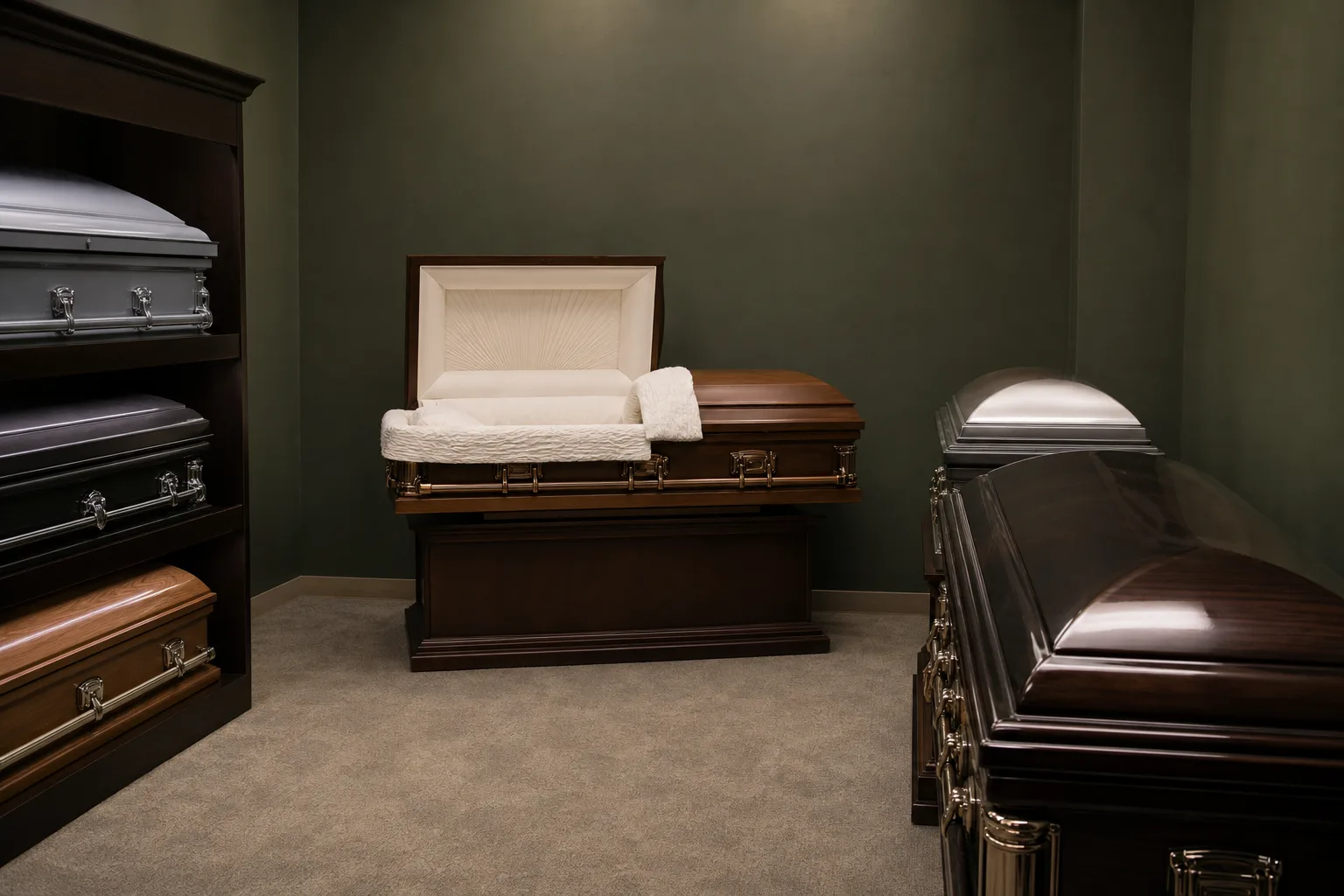
Set aside, for a moment, everything the catalog says about the box, and watch what it is asked to do over about forty-eight hours. It holds a body for viewing in a room full of people who will look at it closely. It gets carried, wheeled, lifted into a vehicle, unloaded, and set on a lowering device over an open grave. Then it goes down, and the grave is closed, and nobody sees it again. Three jobs. Two of them are over by early afternoon on the day of the burial.
That split is the single most useful thing to understand before you look at a price list, because the money follows the visible part almost entirely. Finish quality, hardware, the interior fabric, the crepe and the pillow, the adjustable bed, the way the lid halves meet: all of that is bought for a room with chairs in it. The structural part, the shell that has to survive being carried by six people and lowered eight feet, is comparatively cheap to build and does not vary much across the middle of the market.
What the container does before the graveside
During a viewing, the container is a frame. It sets how the body is presented, how high the head sits, how much of the interior shows, and what the room reads as when people walk in. Funeral directors will tell you, plainly, that the difference between a modest unit and an expensive one is mostly apparent from four feet away and mostly gone from twenty. Handling is the second job and it is real: bar hardware has to hold weight, hinges have to work under stress, and the shell has to stay square when it is carried unevenly by people who have never done it.
Both of those jobs are finished within a few hours. A rental shell exists precisely because someone noticed this. It is a full outer casket with a removable inner container, used for the viewing and the service, and returned afterward, with the inner unit going to cremation or burial. The presentation job gets done at full quality. The permanent job gets done by something plain. If the service matters more to your family than the object does, that split is worth pricing out.
What it does once the grave is closed
Underground, the container is doing very little that you will ever verify. Sealed units with a gasket and a locking bar are sold on the idea of resisting the entry of air and water, and no seller can honestly promise that the contents are preserved, because nothing about a closed grave can be checked. What actually keeps the ground stable is not the casket at all. It is the outer burial container, the concrete or polymer box that surrounds it, which most cemeteries require so that the grave does not settle and the mowers can run level over the section. That is a cemetery product, priced separately, and it is frequently the second-largest line on the bill.
The four decisions, and what each one costs you
The first decision is material and construction: steel of a given thickness, hardwood, veneer over softwood, or cloth-covered composite. That decision sets the widest range on the bill, from a few hundred dollars to well past ten thousand, and it is worth reading a breakdown of gauge numbers and wood species before you look at anything on a showroom floor, since the sticker is counting things that are not obvious.
The second decision is where you buy it. Under the Federal Trade Commission's Funeral Rule, which governs how funeral providers price and disclose goods and services, a funeral home has to accept a container you bought elsewhere and cannot charge you a handling fee for it. That is the whole basis of the third-party market: a Casket ordered online, shipped overnight to the funeral home, will often land at a fraction of the showroom price for a comparable build. You are trading a delivery window and a photograph for a large number of dollars, and for many families that trade is easy.
The third decision is the outer burial container, and it is not really yours. It belongs to the cemetery, whose written regulations specify whether a grave liner or a full vault is required, and in what material. Some of what you will be told is written in the rules and some of it is house preference, and the two are worth separating in a phone call before you buy anything.
The fourth decision is whether you need a purchased casket at all. Direct burial in an unfinished wood or composite container, a rental shell for the service, a cardboard cremation tray, a shroud where the cemetery allows one: each of these does one or two of the three jobs and skips the rest. That is the decision that changes the total most, and the one that gets raised least often at the arrangement conference.
Take the price list home and read it against those four questions rather than down the column. Most of what looks like a single large expense is four separate ones stacked together, and three of them can be answered before you walk back in.